
Game Mechanics Taxonomy
- Home
- Game Mechanics
- Game Mechanics Taxonomy
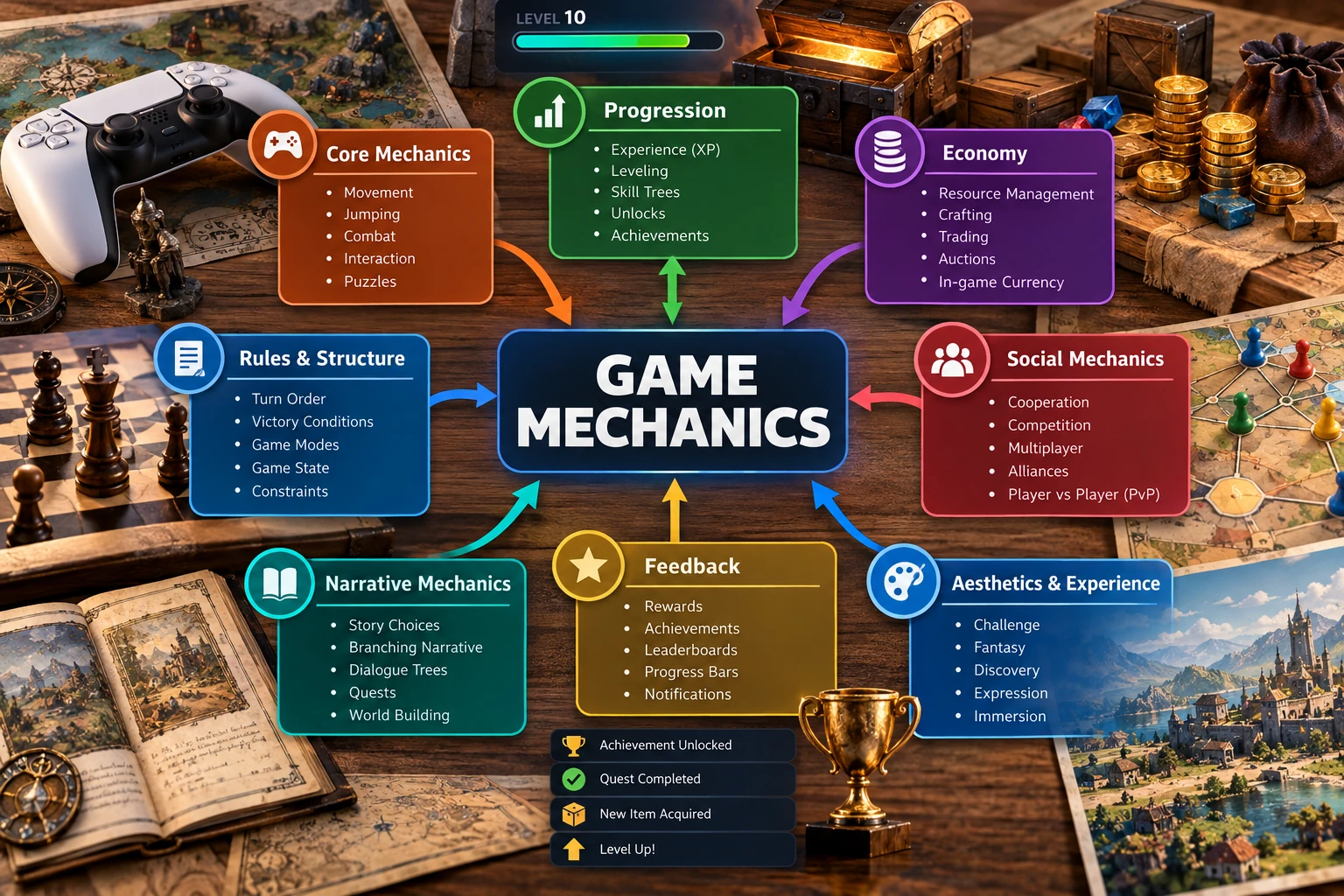
Game mechanics turn rules into changes in game state. A jump changes a character's position; spending a resource changes an inventory; voting changes a shared decision; drawing a card introduces information and uncertainty. Those actions can be compared across video games, board games, role-playing games, and gamified systems.
There is no single universal taxonomy. Jesse Schell groups fundamental design properties, Ernest Adams and Joris Dormans group interacting systems, and Geoffrey Engelstein and Isaac Shalev catalog tabletop mechanisms. Video-game research and gamification models add other lenses. Overlap is inevitable: the frameworks classify different aspects of play. Keep the original labels when citing a framework. For a working inventory, assign each mechanic one primary family and any necessary secondary tags.
A quick classification test: identify the player's action or trigger, the state variable affected, the rule governing the change, the feedback given, and the decision enabled. Decoration and emotional goals can shape the experience without constituting a playable rule.
What counts as a game mechanic?
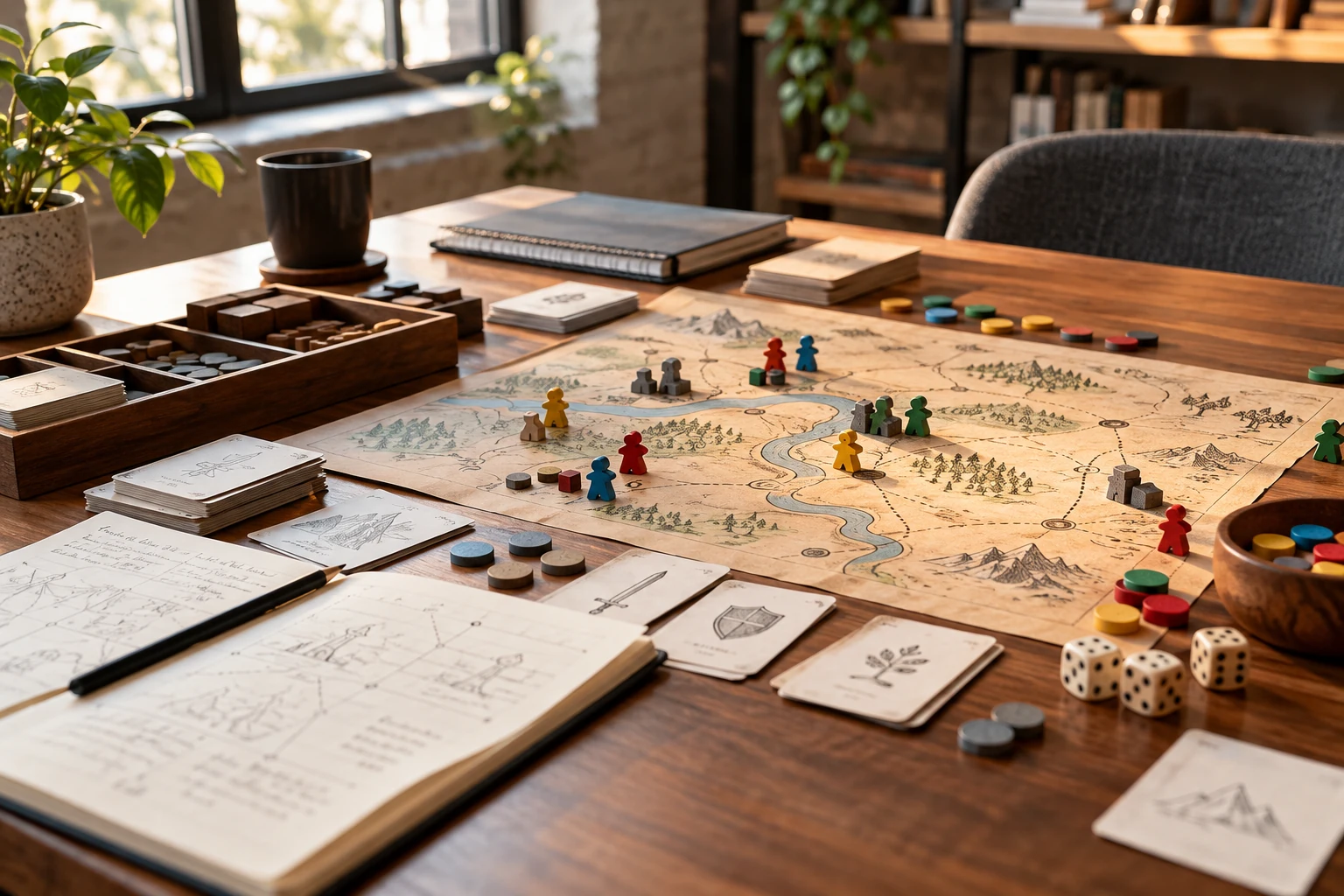
A game rule says what is allowed. A mechanic applies the rule when an action or event changes game state. A game system connects several mechanics. Their interaction produces gameplay dynamics; how those dynamics feel to the player contributes to player experience.
Take a locked door. It is an object, not a rule. The key check is a mechanic: it tests the inventory, then changes the door from locked to open. Lockpicking introduces a skill check, timing challenge, or puzzle. The chase that follows emerges from several systems working together.
The same distinction applies to a health bar: health points and damage rules determine state, while the HUD bar communicates it. A badge is a reward component; its achievement system checks eligibility, tracks events, and displays feedback. A role-playing game (RPG), platformer, roguelike, or 4X strategy game is a genre or design family, not an individual mechanic. Fantasy and science fiction describe setting, not player actions.
Some researchers call a small, reusable unit of play a ludeme. The terms game feature and design pattern also require a clear unit of analysis. Whatever the label, ask: what can happen, under which conditions, and with what outcome?
Five established ways to organize game mechanics
| Framework | Categories and emphasis | Best used for | Key limitation |
|---|---|---|---|
| Jesse Schell | Space; Objects, Attributes, and States; Actions; Rules; Skill; Chance | Dissecting an individual mechanic into fundamental design properties | These are dimensions of design, not mutually exclusive lists of genres or features |
| Adams & Dormans | Physics; Internal Economy; Progression Mechanisms; Tactical Maneuvering; Social Interaction | Mapping systems and distinguishing emergence from scripted progression | A single action may participate in several families |
| Engelstein & Shalev | 13 mechanism families spanning turn order, resolution, economics, movement, cards, and more | Board-game design, cataloging, and mechanism comparison | Primarily tabletop-oriented; digital implementations need added descriptors |
| Ali, Tajuddin & Bramantoro | Core; Meta; Feedback; Social; Narrative; Aesthetic | Broad video-game feature mapping | Some groups include presentation or monetization features as well as procedural mechanics |
| Werbach & Hunter | Dynamics → Mechanics → Components | Gamification, reward programs, learning activities, and engagement systems | Not a comprehensive dictionary of videogame actions or tabletop mechanisms |
Schell: six fundamentals
Space describes topology, boundaries, positions, and relationships; Objects, Attributes, and States describes what exists and which variables can change. Actions defines available verbs, Rules constrains them, Skill describes player capabilities being tested, and Chance accounts for probabilistic results. A jump involves space, movement actions, a grounded-state check, skillful timing, and potentially a random hazard. One jump can involve all six dimensions at once.
The iGaming Mechanics Classification framework separates game systems into four decoupled architectural layers: Core Outcome Engine (RNG vs continuous multiplier), Progression Layer (cascades, persistent meters, bonus trails), Reward Geometry (paylines, ways, cluster, scatter pays), and Player Interaction Model (single-spin, dual-bet cashout, interactive pick-and-click).
Adams and Dormans: five families of interacting systems
Physics governs movement, collision, velocity, gravity, and forces. Internal economy governs the creation, conversion, exchange, and destruction of quantities such as currency, food, health, and energy. Progression mechanisms structure access to content or capabilities. Tactical maneuvering concerns the positioning and use of units or powers; social interaction defines player-to-player exchanges. The distinction between emergence and progression is especially useful: chess produces an enormous variety of encounters from a compact rule set, whereas a scripted mission controls the sequence of challenges more tightly. A game can contain both.
Engelstein and Shalev: 13 tabletop mechanism families
Their encyclopedia organizes mechanisms under Game Structure, Turn Order and Structure, Actions, Resolution, Game End and Victory, Uncertainty, Economics, Auctions, Worker Placement, Movement, Area Control, Set Collection, and Card Mechanisms. Those distinctions separate simultaneous action selection from random turn order, and open drafting from card-driven action. Trick-taking, deck building, worker placement, auction bidding, route building, tile placement, variable player powers, and push your luck describe actions more precisely than “strategic.”
Contemporary video-game and progression models
Ali, Tajuddin, and Bramantoro's 2024 literature review classifies video-game mechanics as core, meta, feedback, social, narrative, and aesthetic. In that scheme, movement, shooting, and puzzle solving are core features; leveling and skill trees belong to meta systems; achievements and rewards provide feedback; multiplayer and chat enable social interaction; dialogue trees support narrative choice; and graphics or audio contribute to aesthetic presentation. Treat graphic style as presentation unless it changes a rule or player decision.
Progression needs a second layer. Tibor Guzsvinecz distinguishes skill-based, XP-based, item-based, narrative, social, and hybrid progression. They distinguish: Is the player becoming more capable, is the character becoming stronger, is better equipment granting new options, or is the story opening new paths?
Werbach and Hunter: dynamics, mechanics, components
In this gamification model, high-level dynamics include constraints, emotions, narrative, progression, and relationships. The ten mechanics are challenges, chance, competition, cooperation, feedback, resource acquisition, rewards, transactions, turns, and win states. Implementations include points, levels, badges, achievements, avatars, quests, boss fights, collections, teams, leaderboards, gifting, tier progression, a social graph, combat, and virtual goods. A leaderboard is not the entire competitive system. A badge is no proof of motivation.
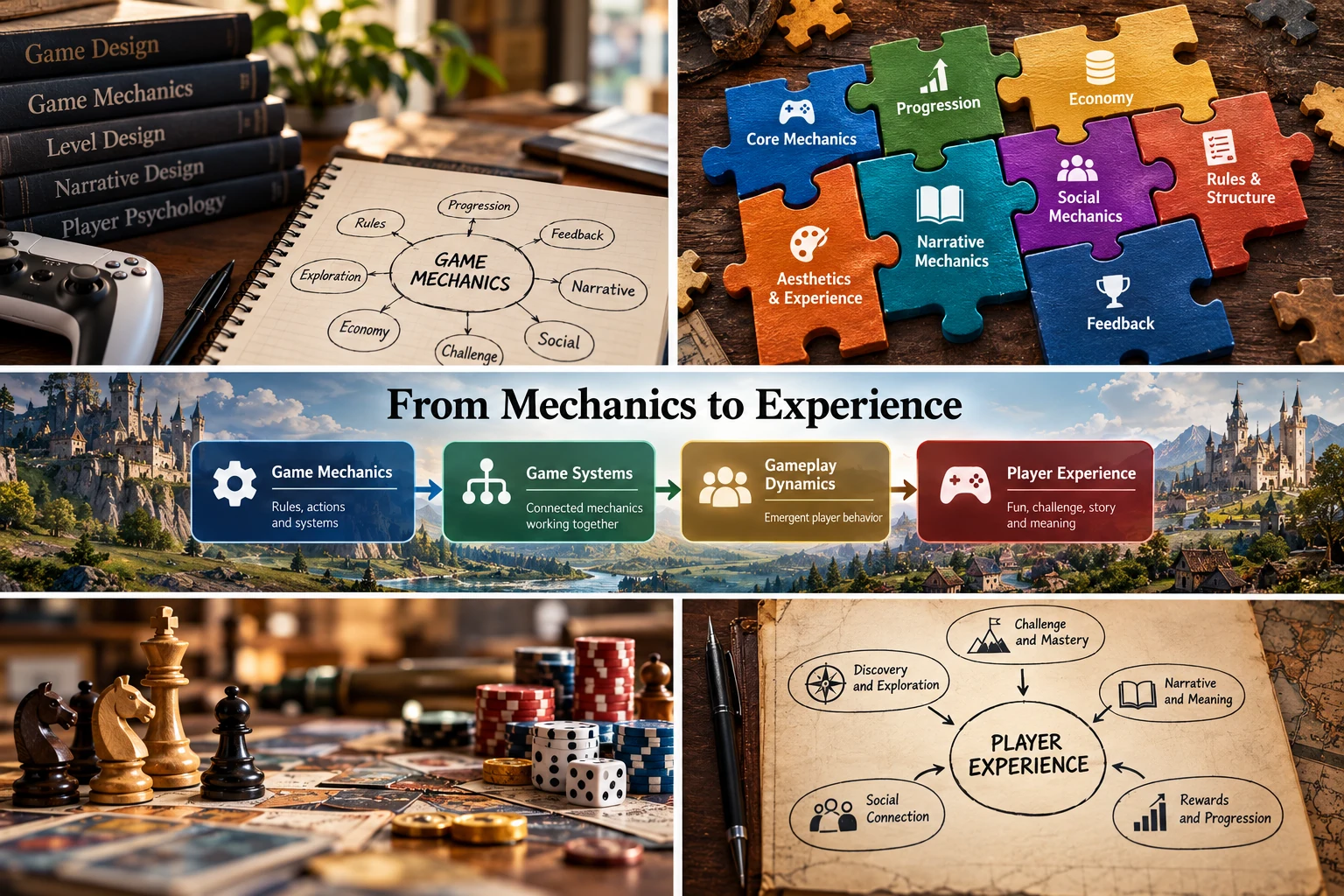
A practical game mechanics taxonomy: eight operational families
In a mechanic library or game design document, classify entries by the operation a mechanic primarily performs. Add secondary tags for its scope, input, timing, player count, information visibility, persistence, and dependencies. The eight operational families are a practical synthesis, not one author's published scheme.
1. Movement, navigation, and direct player actions

Movement mechanics translate controller input or rule triggers into a change of position or interaction. Examples include walking, jumping, double jumping, dashing, dodging, climbing, swimming, driving, flying, teleportation, grappling hooks, parkour, momentum-based traversal, wall running, fast travel, and interacting with objects. Vent crawling, ladder climbing, locked doors, and zone-to-zone unit movement introduce further constraints.
Specify whether traversal is grid-based, point-to-point, free movement, path-dependent, physics-based, or action-point limited. A platformer may reward precise jump arcs and collision timing; a strategy game may use movement points, line of sight, zones of control, and terrain cost. The controls differ; both systems change position under rules.
Ask whether traversal is the challenge or simply carries a player between challenges. A double jump that opens a new route changes the game; a cosmetic jump animation does not. Accessible remapping, auto-run, camera assistance, and input buffering may alter execution without changing the core objective.
2. Combat, defense, stealth, and tactical conflict
Combat rules govern damage, threats, positioning, and responses. Common examples are aiming, shooting, reloading, melee attacks, blocking, parrying, counterattacking, cover systems, critical hits, enemy targeting, status effects, cooldowns, hit points, armor, and damage resistance. Stealth adds crouching, detection cones, noise, infiltration, hiding bodies, line of sight, and stealth takedowns.
Separate the damage model from the defensive option and from the encounter structure. A parry is a timed rule that may prevent damage and create an opening. A boss fight is an encounter that combines attacks, telegraphs, enemy behavior, phases, and victory conditions. Tactical positioning, unit command, area control, territory capture, fog of war, flanking, and simultaneous orders belong here when spatial conflict determines the outcome.
Start with the skill the encounter demands. A narrow dodge window tests execution. Cover rewards position; an ambush with hidden information tests inference. If enemies cannot signal their attack state, a difficult parry may feel arbitrary rather than demanding.
3. Resources, crafting, economics, and construction
Every internal economy needs sources, stores, sinks, and exchange rules. Resource collection, mining, harvesting, inventory management, equipment slots, health pickups, currency spending, trading, buying and selling, upkeep, loans, crafting recipes, item durability, and resource conversion all modify quantity or ownership. When supply and demand matter, markets and auctions add pricing decisions. When spatial capacity matters, grid inventory and Tetris-style inventory introduce placement constraints rather than merely counting items.
In tabletop games, worker placement, action selection, card drafting, set collection, engine building, deck building, stock holding, pick-up and deliver, and network or route building compete for limited actions or resources. In digital strategy games, base building, city building, construction queues, technology trees, production chains, and territory management spread those decisions across multiple turns or sessions. A renewable resource with no meaningful sink can make later decisions trivial; a nonrenewable resource with unclear costs can trap the player.
Example: a crafting system connects gathering → inventory → recipe validation → item production → equipment or trade. It should not be cataloged as just “crafting” if the design question concerns scarcity, carrying capacity, or the player's reasons to explore.
4. Turns, timing, uncertainty, and outcome resolution
Turn and resolution rules determine when an action happens, what it costs, and how the game settles it. They include turn taking, turn-order auctions, initiative, simultaneous action selection, variable phase order, action points, real-time input, countdowns, timers, cooldowns, reaction windows, and programmed movement. Outcome resolution can involve dice probability, random-number generation (RNG), card draws, rerolls, random events, hidden information, skill checks, opposed rolls, or deterministic comparisons.
Hidden information is not the same as random chance. An unseen opponent's decision creates hidden information even when no dice are rolled. Push your luck asks players to trade a larger potential payoff against rising failure risk; risk versus reward can also be fully deterministic. Other patterns include mixed success, fail forward, random production, sudden death, player elimination, and victory points used as a resource.
Separate input uncertainty (unknown map, concealed hand), resolution uncertainty (dice result), and opponent uncertainty (unpredictable choice). Give players enough signals, understandable odds where relevant, and a chance to respond.
5. Progression, rewards, and feedback
Progression changes what players can do or reach, either during a run or across sessions. Examples include experience points (XP), leveling up, character classes, perks, skill trees, ability learning, equipment upgrades, quest progression, gated content tiers, collectibles, reputation tiers, account progression, meta-progression, and New Game Plus. Skill-based improvement can occur even without a numerical level; the player learns timing, strategy, or pattern recognition while the avatar remains unchanged.
Feedback reports the result. Damage numbers, health bars, progress bars, minimaps, status indicators, audio cues, haptic feedback, visual effects, scores, achievements, badges, leaderboards, notifications, and high-score records may reveal success or make goals legible. The reward schedule determines when benefits arrive. Fixed-ratio, variable-ratio, fixed-interval, and variable-interval schedules produce different expectations, but a schedule is not automatically evidence of enjoyment.
Some gamification glossaries include daily rewards, appointment mechanics, streaks, behavioral momentum, communal discovery, loyalty programs, ownership, status, and urgent optimism. These are often better recorded as engagement patterns or design intentions until the concrete trigger, rule, and state change are identified. Loot boxes, paid random rewards, and microtransactions should be labeled with their monetization role rather than blended into ordinary earned progression. They can create ethical, regulatory, and player-trust concerns.
6. Narrative, quests, discovery, and puzzles
Narrative rules store and act on story choices. Dialogue trees, branching narrative, character relationships, moral choices, multiple endings, NPC interactions, companion systems, faction reputation, narrative events, and story progression belong here when choices alter access, information, consequences, or future scenes. A cutscene is primarily a presentation technique unless its timing or interaction rules affect play.
Quests, missions, objectives, environmental storytelling, exploration, investigation, discovery, and puzzle solving can bridge narrative and operational families. A lock-and-key puzzle tests object state; a deduction puzzle tests information; an environmental puzzle tests spatial reasoning; a timed dialogue decision tests both narrative choice and timing. Pattern recognition, memory, matching, logic, and word or knowledge puzzles should be distinguished by the reasoning demanded, not just by their appearance.
A branching story needs a state variable: a relationship score, quest flag, or piece of discovered evidence. If every dialogue choice leads to the same state without a meaningful change in information, the branch may be expressive rather than consequential.
7. Multiplayer, cooperation, competition, and social exchange
Social rules shape what players can do to or with one another. Examples include player versus player (PvP), player versus environment (PvE), cooperative play, teams, guilds, alliances, gifting, player trading, negotiation, voting, shared objectives, role assignment, asymmetric information, betrayal, and communication systems. A party-based game may combine task allocation, shared inventory, role specialization, and revive actions. A social-deduction game relies on hidden roles, accusations, discussion, and majority voting.
Do not confuse these rules with the game mode: online multiplayer is an access arrangement, while cooperation or competition describes the operative relationship. Team-based play does not guarantee cooperation if incentives reward individual score at the group's expense. A leaderboard can encourage competition, but a shared team goal can produce a different dynamic with the very same scoring interface.
Cooperative and competitive systems can fail in predictable ways. Check whether one player can monopolize decisions, whether matchmaking creates unfair skill gaps, and whether communication is essential for success. Asynchronous turns, ping systems, accessible chat options, and cooperative information sharing can reduce friction without changing the game's fundamental objective.
8. Game structure, presentation, and meta systems
Structural rules establish starts, endings, saves, resets, and mode changes. These include victory conditions, defeat states, checkpoints, manual saves, permadeath, respawning, difficulty selection, adaptive difficulty, rubber-banding, randomized setups, campaigns, scenarios, solo modes, session limits, and content gating. A rogue-like run can combine procedural generation, permanent run failure, random drops, and persistent meta-progression; these should be recorded as separate, connected systems rather than as one indivisible “roguelike mechanic.”
Presentation and accessibility affect whether players can read and execute the rules. Examples include the heads-up display (HUD), diegetic inventory, fixed camera angles, dynamic camera modes, readable notes, audio prompts, haptic cues, subtitles, input remapping, and accessibility toggles. A camera is usually an interface component, but when vision limits what the player can detect, it becomes part of the operative rule. Modding, cosmetic customization, monetization, and save systems should receive explicit feature tags so they are not mistaken for the same kind of interaction as jumping or trading.
How to classify a mechanic without losing its meaning
To classify a mechanic that is missing from existing catalogs, record:
- Verb and trigger: Who or what initiates the operation - player input, timer, AI, collision, or rule event?
- Target and state change: Which object, resource, location, relationship, or flag changes from one value to another?
- Constraints and resolution: What are the costs, eligibility conditions, skill windows, probabilities, and failure conditions?
- Primary family: Classify by the direct operation, not by the overall genre or intended emotional response.
- Secondary tags and dependencies: Include mode, platform, persistence, difficulty, information visibility, feedback channel, and neighboring systems.
- Observable outcome: Name the feedback players receive and the resulting decision they can make.
Worked example: timed parry
Trigger: The player presses a defense input during an incoming attack. Precondition: The character is eligible to defend and the attack is inside a defined timing window. State transition: An incoming hit is canceled or reduced; the attacker may enter a stagger state. Primary family: Combat and defense. Secondary tags: Real-time timing, skill, risk/reward, animation feedback, and counterattack opportunity. Dependencies: Enemy telegraphs, hit detection, input latency, cooldowns, and damage rules. Verification: Does the same telegraph reliably imply the same window, and can the player recognize a successful parry?
Compare parry with shield blocking. Both may prevent damage, but blocking could consume stamina continuously while parrying depends on a shorter timing window. Classifying them under defense is useful; merging them into one mechanic loses information needed for combat balancing.
Apply the same record to card drafting (select a card from a limited offer), worker placement (occupy a slot to claim an action), branching dialogue (select a line that updates story state), and dynamic difficulty (change challenge parameters according to measured performance). Add secondary tags where needed; change the primary family only if the operation changes.
Game examples: one title, several interconnected mechanics
| Game | Mechanics that interact | Design relationship worth studying |
|---|---|---|
| Chess | Alternating turns, grid movement, legal captures, check, checkmate, hidden future intentions | Simple deterministic rules yield emergent tactical depth without random outcome resolution. |
| Minecraft | Mining, resource collection, crafting, inventory, construction, exploration, survival | Gathering feeds crafting, crafting enables new tools, and new tools expand reachable opportunities. |
| Portal | Spatial portals, physics, momentum, environmental puzzle solving, object manipulation | One traversal rule creates several different puzzle structures. |
| Slay the Spire | Deck building, card draw, energy, turn order, enemy intent, relics, encounters | Resource scarcity and uncertainty make deck composition a meaningful long-term decision. |
| Stardew Valley | Farming, day-night timing, selling, crafting, upgrading, quests, relationships | A shared daily time budget connects economic, social, and progression decisions. |
A mechanic label tells you less than its role in a specific game. Two games may use resource management but create different dynamics: a survival game asks whether enough food remains for tomorrow, while a deck-building game asks whether enough energy remains for the current turn.
Avoiding Mathematical Cognitive Overload in Hybrid Titles
Layering more than three distinct secondary mechanics (e.g., Hold and Win + Expanding Multipliers + Persistent Collection Meters) within a single title frequently degrades player comprehension and increases session fatigue. High-performing titles establish a clear primary hook and allow secondary mechanics to trigger exclusively during bonus transitions.
Mechanics, gameplay loops, and feedback systems
A mechanic rarely works alone. A core gameplay loop is the repeated short sequence that makes each decision relevant; a meta loop connects sessions through persistent goals, achievements, or mastery.
Explore → Collect resources → Craft tools → Access a new area → Explore
That cycle requires available resources, inventory room, workable recipes, navigable space, and equipment gates. If crafted tools provide no new possibility, the progression loop stalls. If gathering is effortless and inventory is unlimited, resource selection stops being meaningful.
Feedback loops also differ in direction. Positive feedback amplifies advantage: better equipment helps players earn even better equipment. Negative feedback counteracts divergence: catch-up systems or rubber-banding can keep a contest viable. Positive feedback may make strategic investment satisfying, but can cause runaway leaders; negative feedback can preserve suspense, but may undermine a player's sense that skilled decisions matter.
Deterministic rules, emergent behavior, and scripted sequences can coexist. Emergence occurs when interactions produce outcomes that were not explicitly authored case by case. Progression structures can still guide the order of challenges. The challenge is to leave room for surprising choices without losing the intended pace.
Choosing mechanics for a new game
Design the decision before the feature. A feature with no consequential choice may not deserve its own system.
- Name the intended player decision. “When should I risk another draw?” is more precise than “make the game exciting.” Push-your-luck resolution fits the first problem; an achievement badge does not solve it.
- Pick one primary interaction. In a platformer, start with running and jumping. In a negotiation game, begin with offers and accept/reject rules. In a survival game, begin with resource collection, consumption, and scarcity.
- Add constraints that create trade-offs. Action points, cooldowns, limited inventory, time pressure, terrain, probability, or imperfect information matter when players can respond intelligently.
- Connect actions to readable feedback. Telegraph danger, reveal cost, clarify success and failure, and make progress understandable through animation, sound, interface, or text.
- Add progression only where it changes options. Skill trees, XP, new abilities, better items, story gates, or social ranks should alter decisions rather than merely increase numbers.
- Test the whole loop. Look for repetitive dominant strategies, dead resources, unclear failures, excessive randomness, stalled progression, and inaccessible controls.
For board games, a few cards and tokens can test the action economy. For digital games, a graybox can expose broken movement, combat timing, or puzzle logic before art production. For gamified applications, test whether the real activity still matters once the reward disappears.
How to verify that a mechanic works
Watch what players actually do, not just what they say they enjoyed. For a jump, track time to first successful use, failure rate, and recoverability. For a crafting economy, track resource acquisition, stockpiling, useful conversions, and unused items. For a competitive system, track dominant strategies, comeback frequency, and perceived fairness. For a cooperative mechanic, note who proposes actions, whether roles are complementary, and whether one person can make every decision.
A useful test changes one condition at a time. Let new players try without coaching, observe the first failure, ask what outcome they expected, and then repeat after changing one rule. Then compare it with a simpler version or one without the feature. Watch for problems such as input latency, insufficient telegraphs, opaque probabilities, runaway rewards, or required information that the interface never shows.
Session length can mislead. A longer session can signal enjoyment, confusion, or inability to find a stopping point. Collecting rewards does not mean the underlying task was worthwhile. A lower completion rate does not prove a game is badly balanced if the intended challenge is demanding; pair completion data with player comprehension and voluntary retry behavior.
Check side effects as well as the intended outcome. If an adaptive difficulty system raises completion, check whether it reduces perceived mastery. If a daily reward increases return visits, check whether players still complete the core activity without the reward. If a social leaderboard raises activity, check whether it discourages beginners or invites harassment.
Common taxonomy mistakes and how to avoid them
- Confusing genre with mechanic: “RPG,” “simulation,” and “4X” identify broader game patterns; skill trees, resource trading, and unit command identify more specific operations.
- Confusing an object with its rule: A card, coin, timer, map, badge, or avatar is not automatically a mechanic. Ask how its state is changed or evaluated.
- Classifying by emotional promise: “Fun,” “immersion,” “flow,” “mastery,” and “fantasy” describe intended experience. Identify the actions and feedback likely to support them.
- Assuming every category is exclusive: A timed stealth takedown is simultaneously combat, timing, movement, detection, and resource risk. Use primary and secondary tags.
- Equating feedback with progression: A progress bar reports state; an upgrade changes capability. They may be connected but they do different jobs.
- Treating randomness as strategy: An RNG loot drop is uncertain, but meaningful choice requires players to understand or influence its consequences.
- Ignoring player constraints: A mechanic that requires rapid input, audio recognition, or precise color discrimination may exclude players without appropriate alternatives.
- Including every catalog label: Catalogs may index camera styles, props, encounters, interface options, and design tropes. A useful taxonomy names their type rather than flattening them into interchangeable rules.
Frequently asked questions about game mechanics taxonomy
What is the difference between game mechanics and game dynamics?
A mechanic specifies a rule or state change. Dynamics are behaviors that emerge when those rules meet player choices: scarce resources can prompt hoarding, negotiation, or alliances.
How many types of game mechanics are there?
No fixed number exists. Each taxonomy defines its own unit of analysis, while open catalogs keep adding new mechanism labels and variations.
Are achievements, points, badges, and leaderboards mechanics?
They are generally elements or components. The mechanics specify how players earn points, claim badges, or rank on a leaderboard; Werbach and Hunter make this distinction explicit.
Is difficulty a mechanic?
Difficulty is primarily a property of the challenge, but difficulty scaling becomes a mechanic when a rule changes enemy behavior, resource availability, timing windows, or other game state in response to a trigger. A static “Hard” label alone is a setting.
Can a game have multiple core mechanics?
Yes. A game may be built around moving, shooting, building, and resource collection. The core loop should show how those actions connect and what decision players face repeatedly.
Should tabletop and video-game mechanics share the same taxonomy?
They can share broad operational families such as movement, resource allocation, hidden information, and turn resolution. Digital-specific concepts - camera control, automated physics, save states, input latency, and procedural generation - need additional descriptors. Keep platform-specific rules as secondary tags.
What makes a mechanic genuinely innovative?
Novelty may lie in a new constraint on a familiar action. A distinctive portal traversal rule, a new information exchange, or a resource that also acts as a victory condition can create new decisions without requiring an entirely new genre. Playtests should reveal a new decision, not merely a new name.