
Innovation vs. Reskinning in Casino Games
- Home
- Product Innovation
- Innovation vs. Reskinning in Casino Games

A slot can have a new name, a different soundtrack, animated characters, and an entirely fresh color palette while playing almost exactly like its predecessor. Another release may look familiar but change how symbols combine, how bonus rounds unfold, or how risk is distributed. The practical distinction is not whether a casino game looks new. It is what changes after the first spin - and whether that change matters to the player.
To judge originality, compare the artwork, rules, math, feature interactions, and any choices players can make. A cosmetic change affects mainly the first layer. A meaningful redesign changes at least one of the others in a way that can be demonstrated, not merely advertised.
What Counts as a Reskin, a Variation, or an Innovation?
Reskinning generally means reusing an established game framework while replacing assets such as symbols, background art, music, animations, and narrative theme. A pirate-themed slot can become a mythological adventure without changing the reel layout, paytable structure, bonus trigger, or fundamental gameplay loop. That is not necessarily deception: familiar mechanics can be enjoyable, and visual execution takes creative work. But a new aesthetic alone does not establish a new product experience.
A mechanical variation retains a recognizable framework while changing a consequential rule: perhaps a multiplier accumulates across cascades, a bonus has an additional state, or a reel modifier affects symbol behavior. Product innovation goes further when the interaction creates a distinct pattern of play, a new decision, or a demonstrably different relationship between events and outcomes. These are useful analytical categories rather than universal regulatory classifications.
| Dimension | Typical reskin | Meaningful innovation | What to verify |
|---|---|---|---|
| Theme and interface | New symbols, story, animations, audio | Presentation changes how players understand or interact with the game | Does the theme affect rules or only appearance? |
| Base-game rules | Same reel configuration and win evaluation | Different symbol behavior, reel transformations, or win logic | Compare game rules and pay evaluation |
| Bonus design | Renamed free spins or familiar hold feature | New feature states, transitions, or choices | Compare trigger, sequence, and resolution |
| Math model | Similar RTP, volatility, hit patterns | Materially altered outcome distribution or pacing | Check disclosed figures; avoid inferring hidden probabilities |
| Player agency | Identical decisions and autoplay rhythm | New meaningful choices or interaction modes | Identify choices and their actual consequences |
Why So Many New Slots Feel Familiar

Modern online slots are assembled from reusable building blocks. Paylines, ways to win, scatter symbols, wilds, multipliers, free spins, cascading reels, and hold-and-spin features can be combined in many ways. Reusing a proven game engine or mathematical framework may reduce development effort, simplify quality assurance, and make a release easier to explain to players. Those commercial incentives help explain the industry's rapid release cadence, but they do not prove that every similar title is a clone.
A structural math audit evaluates hit frequency distribution, bonus round trigger probability (typically 1 in 100 to 1 in 150 spins), and top-tier win cap constraints. When two titles exhibit an identical Pearson correlation coefficient across their paytable weightings, the game represents an asset swap rather than an authentic mathematical iteration.
Casino operators and aggregators also manage large game portfolios. A provider may value reliable cross-platform HTML5 performance, familiar user interfaces, and compatibility with existing distribution systems. A recognizable mechanic can reduce the learning effort for a player encountering a new title. The trade-off is content inflation: an expanding catalog in which genuinely different experiences become harder to identify.
Copying another game’s artwork is not the same as licensing a mechanic or independently using a common design pattern. These situations carry different creative and intellectual-property implications. Similarity alone cannot establish infringement, and a branded mechanic should not automatically be treated as freely reusable.
The Mechanics That Changed the Design Vocabulary
Megaways and variable reel configurations
Big Time Gaming's Bonanza Megaways is a useful reference point for variable reel-height systems that change the number of possible winning ways between spins. Megaways became a recognizable mechanic across numerous releases, including Extra Chilli Megaways and White Rabbit Megaways. The presence of Megaways in a new title signals a specific game architecture, not proof that the entire title is original. To assess differentiation, examine modifiers, bonus behavior, pacing, and the mathematical profile rather than counting reels alone.
Cascading reels and cluster pays
In cascading or tumbling systems, winning symbols disappear and are replaced, potentially creating additional wins within the same paid round. Gonzo's Quest is a familiar example of avalanche-style play. Cluster Pays instead evaluates connected groups of matching symbols rather than conventional left-to-right paylines; Aloha! Cluster Pays is one example associated with that design family. A game combining cascades and clusters may still be derivative if their interaction is unchanged. The critical question is whether the combination produces a distinct sequence of events or only repackages known behavior.
Hold & Win, respins, and persistent states
Hold & Win-style games commonly lock qualifying symbols while respins provide opportunities to add more. That recognizable loop can be dressed in dozens of themes. Differentiation may arise when symbols change value, new grids open, jackpots interact with collection rules, or persistent features alter the state of play. Such additions should be assessed individually: a different jackpot label is less substantive than a different rule governing how the feature progresses.
Bonus Buy and direct feature access
Bonus Buy can let eligible players pay to enter a feature rather than wait for its ordinary trigger. It changes access and the cost of participation, but does not by itself make the underlying bonus innovative. Availability also depends on jurisdiction and operator configuration. For a US audience, never assume a bonus-purchase option seen in an international demo is offered by a locally licensed real-money casino.
Other variations: xWays, xNudge, and hybrid formats
Nolimit City has used branded mechanics such as xWays and xNudge to alter symbol expansion or positioning within its designs. These illustrate how a recognizable mechanism can become a design system reused across titles. Outside conventional video slots, crash games, live-dealer games, casino game shows, and hybrid formats offer different forms of interaction. A live host or multiplayer display is not automatically an innovation: the underlying rules, timing, and player decisions still matter.
Does a Different RTP Mean a Different Game?
Return to Player (RTP) is a theoretical long-run proportion of wagers returned under a specified game configuration, not a prediction for a particular session. Volatility describes how outcomes are distributed, while hit frequency concerns how often qualifying wins occur. A paytable lists payouts and conditions; an RNG (random number generator) determines outcomes in RNG-based games according to the implemented rules.
Two games can advertise the same RTP and feel quite different if one concentrates returns in rare bonuses and the other produces more frequent smaller wins. Conversely, different RTP settings may exist for substantially the same game design. A changed RTP therefore does not prove a new mechanic, and identical RTP does not prove a reskin. Maximum-win advertising and jackpot figures are equally insufficient without context about their probability and feature rules.
Some providers distribute multiple RTP configurations of a title. A demo, an overseas operator, and a US-facing regulated platform may not offer the same configuration - or the same game at all. When evaluating a specific release, use its actual information screen and published rules rather than figures copied from a review of another version. Undisclosed probabilities cannot be reverse-engineered reliably from a few trial spins.
A Practical Originality Test for Any New Casino Game
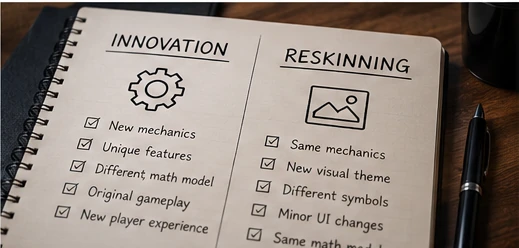
Compare the candidate title with its closest predecessor, not with a random game in the same genre. Use official game rules and, where possible, free-play demonstrations under matching settings.
Portfolio Audit: Clone Identification Matrix
- Match the baseline. Record provider, game version, reel or grid layout, win evaluation, and available features. Do not confuse a sequel, a licensed variant, and a visually similar competitor.
- Strip away the theme. Imagine both games with plain symbols and no soundtrack. Would the spin sequence, triggers, and bonus decisions remain essentially identical?
- Map the feature loop. Write the sequence from base spin to trigger, bonus state, modifier, and resolution. Look for a rule or transition that is genuinely new.
- Check the math disclosures. Compare RTP configuration, volatility descriptions, paylines or ways, minimum and maximum bets, and any stated maximum win. Mark unavailable information as unknown.
- Test meaningful choices. Does the game introduce decisions that affect timing, risk exposure, or feature selection? Are these genuine choices or cosmetic buttons?
- Judge the difference in context. A small rule change may transform play; a large graphical overhaul may leave it untouched. Describe the effect rather than awarding a universal originality score.
A simple working classification is cosmetic reskin when the same game loop survives with changed assets; iterative variation when familiar mechanics gain consequential adjustments; and substantive innovation when rules or interactions create a distinctly different experience. If technical documentation is unavailable, label the conclusion provisional.
Three Comparisons That Reveal the Difference
Scenario 1: New art, identical bonus
Consider two five-reel slots with identical paylines, wilds, scatters, and free-spin rules. One has an Egyptian theme; the other uses a Western setting. If only the symbols, sound, and animation change, the second is a reskin.
Scenario 2: Familiar mechanic, altered risk distribution
Now consider two games using cascading reels. In one, cascades simply continue until no further wins occur. In the other, each cascade changes a persistent modifier that affects later outcomes under clearly documented rules. The second may qualify as an iterative mechanical innovation. Whether the difference is desirable depends on the player's preferences and the actual math model, not the novelty of the modifier's name.
Scenario 3: A brand-new feature label with no new behavior
A provider promotes a “Power Vault” bonus that locks symbols and awards additional respins. If its trigger, lock rules, reset behavior, and awards duplicate a conventional hold-and-win feature, the new name does little to establish originality. A feature label is a marketing claim; the rule sequence is the evidence.
Why Familiarity Is Not Always a Design Failure
Originality does not guarantee a good game. A familiar slot can offer clear navigation, polished animations, accessible controls, stable mobile performance, and an enjoyable theme. Meanwhile, a mechanically ambitious title can bury essential rules, increase cognitive load, or introduce a feature that players rarely understand. Product innovation is valuable when it improves or meaningfully changes the experience - not merely when it adds complexity.
Play’n GO, Pragmatic Play, NetEnt, Hacksaw Gaming, Yggdrasil, Endorphina, SYNOT Games, and ICONIC21 compete in a market shaped by distribution, certification, and frequent releases. Judge individual games by their rules rather than a studio’s reputation or release count.
Reusable engines and AI-assisted tools can speed up concept art, prototypes, assets, and mathematical simulations. They can also make superficial variations cheaper to produce. Neither outcome is inevitable. The relevant test is whether faster production yields better mechanics and more coherent player experiences or simply more titles competing for the same attention.
The US Market Adds Another Layer: Availability and Rules

“Online casino game” does not mean the same thing everywhere in the United States. Real-money iGaming availability and permitted features vary by state, licensing regime, and operator. Social casinos and sweepstakes-style products also differ from regulated real-money casino platforms in important legal and operational ways. A feature advertised on a global provider site may be absent, modified, or unavailable to a US player.
For real-money play, confirm that the operator is authorized in the relevant state, read the game's current rules, and check whether its RTP version and bonus options are disclosed. Responsible-play controls and access to support matter more than novelty. No mechanic, volatility profile, or feature-buy option can eliminate the house edge or guarantee a win.
What Actually Deserves the Label “New”?
A new release earns its claim to originality through a changed win-evaluation system, a different interaction between features, or bonus progression that changes the way a round unfolds. Better presentation matters too, but it should not be confused with new game rules.
Compare the new game’s rules with its closest predecessor. If the only differences are the soundtrack, mascot, and feature names, it is primarily a cosmetic update. If the rules allow a genuinely different sequence of events, there is a stronger case for innovation.
The Hidden Lifecycle Cost of Catalog Duplication
While reskinning lowers production time from 6 months to 6 weeks, excessive catalog redundancy causes rapid portfolio cannibalization. Aggregator telemetry indicates that asset clones experience an average 65% drop in active players within 14 days of release, whereas titles featuring genuine mechanic differentiation maintain steady wagering volumes over 90+ days.
Frequently Asked Questions
Are reskinned casino games necessarily bad?
No. A reskin can be polished and entertaining. The issue is accuracy of expectations: new presentation should not be mistaken for new mechanics or better odds.
Can two slots with identical RTP have different gameplay?
Yes. RTP is an aggregate theoretical measure. Volatility, bonus structure, hit frequency, and feature interactions can differ even when published RTP values match.
Does a Megaways or Hold & Win label guarantee originality?
No. These labels identify recognizable mechanics or mechanic families. Originality depends on the complete implementation and how it differs from comparable games.
Can players tell whether a slot is a reskin without source code?
They can make a reasoned comparison using rules, feature sequences, game information, and demos. They usually cannot establish identical underlying code or hidden probability tables without technical evidence.
Do innovative slots offer better winning chances?
Not inherently. Novelty does not imply a higher RTP, lower house edge, or improved short-term results. Check the specific game configuration and treat gambling as entertainment, not a way to earn money.