
Payment Orchestration in Online Gambling
- Home
- Payments & RegTech
- Payment Orchestration in Online Gambling
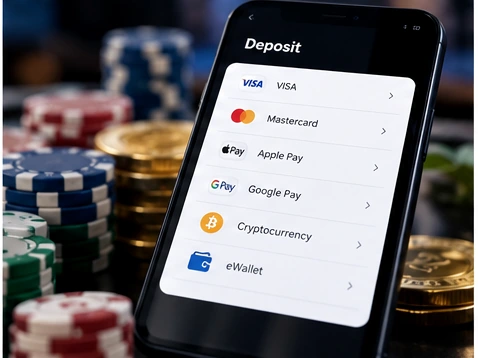
A player tries to deposit $75 at a licensed online casino. The bank declines the card, or the processor stops responding. Those failures may look identical at checkout, but they demand different responses. A blind retry can create a second charge, credit an unfunded player wallet or send a restricted payment to another provider.
Payment orchestration changes online gambling by deciding where an eligible payment should go - and when it must not go anywhere. A routing engine can recover some failed deposits, but only if it knows the player’s eligibility, the processor’s status and the outcome of the original attempt. That same discipline matters when winnings are paid out.
What payment orchestration actually controls
A payment orchestration platform sits between the casino’s cashier or player account management (PAM) system and its payment service providers (PSPs), processors, acquiring banks and alternative payment methods (APMs). One application programming interface (API) can normalize responses and direct transactions to approved partners. It does not replace merchant agreements, an acquiring relationship or the ledger that records player funds.
| Payment layer | Primary job | What it does not guarantee |
|---|---|---|
| Cashier and checkout | Show allowed deposit or withdrawal options, amounts, currencies and player instructions. | Issuer approval or payment settlement. |
| Gateway, processor and acquirer | Transmit payment instructions to the appropriate card network or bank and return transaction responses. | A usable alternative route when the provider fails. |
| Payment orchestrator | Apply smart routing, provider selection, controlled cascading, failover and consolidated reporting. | Permission to process gambling payments or bypass issuer decisions. |
| Operator ledger and player wallet | Track authorized player balances, adjustments, bets, withdrawals, reversals and reconciliation. | Accuracy without correctly handled payment events and internal controls. |
A payment aggregator or merchant of record (MoR) may take on parts of the merchant relationship. An orchestration vendor usually does not. The contract needs to say who settles funds, controls card data, handles disputes and bears operational liability - especially when several companies sell their services as a single package.
Why U.S. iGaming payments are unusually difficult

Online gambling is a state-by-state business, not a nationwide card-acceptance category. The American Gaming Association reported $10.73 billion in U.S. commercial iGaming revenue for 2025, yet licensed online casinos operated in relatively few states. Sports betting follows a different map. A route approved for one state, product and legal entity may be unavailable just across the border.
A deposit approved for a licensed online casino in one state may be ineligible in the next. Acquirers also apply their own rules to merchant category code (MCC) 7995, card type, issuing bank and merchant ID (MID). An alternative acquirer can help with an outage or eligible decline; it cannot be used to disguise the gambling category or bypass an issuer's restriction.
How smart routing changes the deposit journey
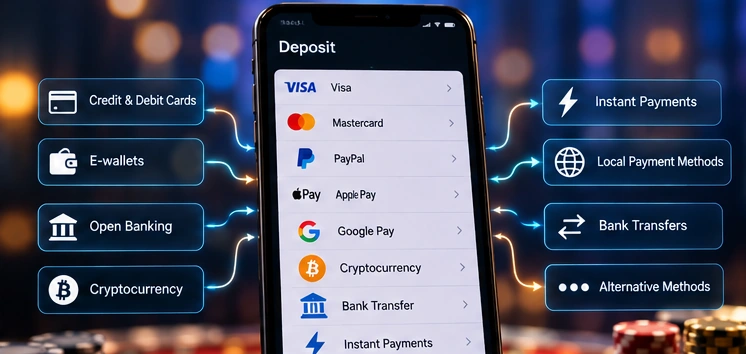
Static routing follows a set rule, such as a preferred acquirer for a specific card type. Dynamic routing weighs bank identification number (BIN), recent issuer responses, fees, risk signals and current PSP health. The candidate routes still have to pass the casino's state, license and payment-method checks.
- Check eligibility. Confirm the player is permitted to transact, including applicable age and identity verification, geolocation, state licensing, deposit limits, self-exclusion status, payment method eligibility and required risk checks.
- Present a valid payment method. The cashier filters card, ACH, bank-transfer or approved digital-wallet options by state, currency, player account status and provider support. Adaptive checkout should not advertise an unavailable method.
- Select the first route. The routing engine evaluates the transaction amount, card type, BIN, issuer country, processing fee, historical approval rate, current provider availability and other permitted variables. Weighted routing or traffic splitting can distribute eligible volume across processors.
- Authenticate and authorize. Where applicable, tokenized card credentials and 3-D Secure (3DS or 3DS2) support authentication. The processor or acquirer forwards the authorization request through the card network, such as Visa or Mastercard, to the issuing bank.
- Interpret the response. A successful authorization, a timeout, a soft decline and a hard decline must not be treated as interchangeable. A fallback route is available only when another attempt is allowed by applicable rules, provider contracts and the available transaction evidence.
- Update the source of truth. Use a canonical transaction ID, idempotency key and auditable payment states. Webhooks, including delayed or out-of-order callbacks, should not create duplicate deposits. The player wallet is credited only in line with the operator's approved funds-availability policy and a verified processor outcome.
At a licensed U.S. online casino, suppose a $75 debit-card deposit times out after the acquirer receives it. Another authorization could produce a duplicate hold if the original request actually succeeded. The payments service checks the first attempt's status before retrying. A circuit breaker can move new traffic away from the failing processor, but an existing payment with an unknown outcome stays pending until it can be resolved.
Cascading and failover are useful only when retries are controlled
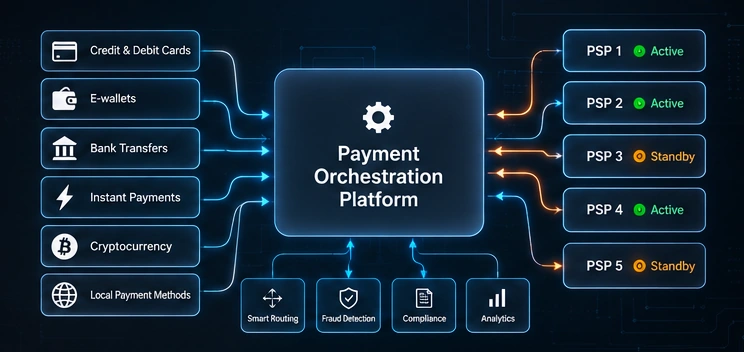
Cascading makes another eligible attempt after a failed payment. Failover redirects new requests away from a processor that is down. They solve different problems. Neither permits unlimited retries: each attempt can add fees, delay and chargeback risk.
Visa resubmission rules and Mastercard Merchant Advice Codes can limit when a card payment may be retried. A retry policy needs separate handling for soft declines, hard declines and timeouts, plus a cap on attempts. A definitive issuer restriction means stop, not try another MID.
Authorized does not mean settled. Capture, settlement and reconciliation each describe a different step. The operator’s double-entry ledger must agree with processor statements and the settlement account, including refunds, reversals and chargebacks. If a dashboard shows “success” but the funds cannot be traced, that success number is not reliable.
Withdrawals make payout orchestration as important as deposits
Deposit dashboards show failures instantly. Withdrawal failures are less visible but often more damaging to player trust. A processor may support card deposits but not card payouts; an account-to-account (A2A) rail may receive funds yet require separate payee verification before sending them. Operators need a distinct payout route, not a reversed deposit flow.
Dynamic Cascading Failover During Acquirer Gateway Outages
During peak sports betting events, primary acquirer gateways can experience sudden degradation. Without orchestration, failed transactions result in lost deposits and frustrated players. An intelligent payment orchestration layer detects rising HTTP 504 errors or soft-decline spikes in real-time, instantly re-routing subsequent transactions through secondary acquirers with pre-configured BIN-level routing rules.
Before releasing winnings, the operator may have to verify identity and account ownership, review anti-money laundering (AML) flags, source of funds (SoF) or source of wealth (SoW), sanctions exposure and account-takeover risk. Return-to-source or closed-loop payouts can limit third-party transfers where supported or required. Withdrawal limits, segregation of player funds and statutory timing rules still depend on the relevant jurisdiction.
An eligible payout might move by ACH, bank transfer, approved instant-payment service, card or e-wallet. The orchestrator has to check each provider’s actual payout support, transfer limits and cost. A processor status of submitted says nothing about whether the player received the money. Track completed receipt, failed disbursements, returned transfers and support requests.
Payments and RegTech must share one policy boundary

The Unlawful Internet Gambling Enforcement Act (UIGEA) and Regulation GG address restricted payments connected with unlawful internet gambling. They do not prohibit every transaction involving a properly licensed state gaming operator. Covered payment-system participants must maintain procedures designed to identify and block or prevent restricted transactions. An orchestrator cannot make a prohibited payment lawful by finding a willing processor.
The Bank Secrecy Act (BSA) and Financial Crimes Enforcement Network (FinCEN) obligations depend on the gaming business's legal classification and activities. They may include AML programs, recordkeeping and suspicious activity reports. Know Your Customer (KYC), customer due diligence (CDD), enhanced due diligence (EDD), sanctions screening and politically exposed person (PEP) checks need assigned owners. FinCEN risk guidance also addresses unusual payment behavior; not every online gaming business falls under the same federal casino rules.
The routing engine generally needs a decision - eligible, review or blocked - not a copy of the player’s identity file. Keep the rule version, verification status, decision reason and final payment outcome in the audit trail. Know Your Business (KYB) checks on PSPs matter too: a technically connected processor may not be authorized to serve a particular U.S. gaming license.
Deposit limits, cooling-off periods and self-exclusion flags must be enforced before authorization. Michigan's online self-exclusion program and New Jersey's responsible-gambling controls illustrate why the casino cashier and compliance system must share account restrictions. A fallback PSP must not reopen a blocked account.
Tokenization reduces exposure, but it does not erase PCI obligations
Card vaulting and network tokenization can reduce repeated card entry and help with processor changes. They do not make every credential portable. A token may be limited to a network, merchant or provider, so the vendor’s token-export and migration terms deserve close review.
The Payment Card Industry Data Security Standard (PCI DSS v4.0.1) applies according to the systems that store, process or transmit cardholder data, and systems that affect their security. A hosted payment form may narrow the casino's assessment scope, subject to its integration and eligibility criteria; a unified API does not automatically do so. SAQ A and SAQ A-EP have distinct conditions. The PCI Security Standards Council also confirms that encryption alone does not remove cardholder data from scope.
Use authenticated webhooks, access controls, isolated token vaults, audit logs and independent security testing. ISO/IEC 27001 can inform the broader security program. Operators entering Europe face separate regimes, including PSD2, Strong Customer Authentication (SCA) and GDPR; UK Gambling Commission (UKGC) and Malta Gaming Authority (MGA) rules apply to their respective licensed markets. U.S. gaming operators should not assume those rules govern their domestic payments.
Which payment methods can an orchestrator realistically support?
Each payment method requires a provider that accepts the casino's jurisdiction, legal entity and transaction type. A single orchestration API cannot provide a missing license or banking relationship.
| Method or rail | Operational opportunity | Key constraint |
|---|---|---|
| Visa or Mastercard debit and eligible credit cards | Familiar cashier experience, network tokens and established dispute processes. | Issuer gambling policies, state or operator restrictions, MCC 7995 treatment, chargeback risk and permitted card type. |
| ACH, local bank transfer and pay-by-bank | Account-to-account deposits or withdrawals and potentially different cost economics. | Account verification, ACH returns, settlement timing, funding risk and the bank's gambling acceptance policy. |
| RTP and FedNow | Potentially faster U.S. bank-to-bank transfers through participating financial institutions. | Specific bank, service-provider and use-case availability; real-time settlement does not automatically mean a gambling operator can access the rail. |
| Approved e-wallets and digital wallets | Fewer repeated card-entry steps where PayPal, Apple Pay, Google Pay, Skrill, Neteller or other products are available. | Product-specific gambling policies, wallet funding source restrictions and payout functionality. |
| International APMs | Pix in Brazil, UPI in India, iDEAL in the Netherlands, Interac in Canada or GCash in the Philippines may support local-market preferences. | These are not interchangeable with U.S. gaming rails; availability depends on local law, partner eligibility and the product's actual capabilities. |
| Cryptocurrency or stablecoin routes | Alternative transfer models involving assets such as USDC or USDT in certain business contexts. | Licensing, custody, sanctions, AML, conversion, volatility and state or federal restrictions; support cannot be assumed for regulated U.S. gambling. |
How to measure whether orchestration actually works

An approval-rate chart can improve while fewer players actually get money into their accounts. Compare similar traffic by state, issuer, card type, method, PSP and period before crediting routing changes. Use metrics with denominators that distinguish attempted payments from funded deposits:
- First-attempt approval rate: approved first authorization requests divided by eligible first authorization attempts.
- Cascade recovery rate: successfully recovered payments divided by declines eligible for a compliant retry, not by all declined payments.
- Deposit success rate: deposit intentions that result in correctly credited funds divided by initiated eligible deposit intentions, measured within a defined window.
- Cashier conversion rate: players completing a funded deposit divided by players beginning the relevant cashier journey.
- Cost per successful payment: total applicable processing, orchestration, retry and operational costs divided by successfully completed transactions.
- Withdrawal completion time: median and upper-percentile time from valid payout request to confirmed receipt, plus returns and failed payouts.
- Risk guardrails: chargeback ratio, ACH return rate, fraud losses, false decline rate, payment abandonment, duplicate-credit incidents and reconciliation exceptions.
To test a new rule, split comparable eligible traffic between the current route and an approved alternative. Keep identity, geolocation and responsible-gambling checks unchanged. Record the routing-rule version. Then examine authorizations alongside settled deposits and ledger entries; issuer mix, promotions, outages and time of day can distort a simple before-and-after comparison.
A deposit is not revenue. Gross gaming revenue (GGR), net gaming revenue (NGR), retention and lifetime value (LTV) depend on actual play, not just whether a card was authorized. A credible return-on-investment (ROI) calculation weighs completed deposits against processing fees, foreign-exchange (FX) charges, orchestration subscriptions, support costs, fraud, returns and refunds. Recovering a $100 deposit does not create $100 of profit.
When orchestration is worth buying - and when it is not
Several approved PSPs, uneven issuer acceptance or repeated outages can justify orchestration. A single-state casino with one dependable processor may have little to gain after platform fees and engineering work. Compare recoverable failures and processing costs before selecting a vendor.
Building a routing engine gives the operator direct control over rules and transaction records, along with the burden of engineering, PCI review, monitoring and incident response. Buying one can shorten integration work, but adds platform fees, a service-level agreement (SLA) and another failure point. A backup PSP cannot help when the orchestration layer itself is down.
Praxis Tech, PaymentIQ, Corefy, IXOPAY, Primer, BridgerPay and Juspay operate in the broader orchestration ecosystem; listing a provider does not establish its approval for any particular U.S. gaming license. Request a written matrix of supported states, merchant IDs (MIDs), acquirers, legal entities and withdrawal rails. Ask how payment tokens and transaction logs can be exported when the contract ends.
Six checks before signing a payment orchestration contract
- Licensing fit: Can each proposed PSP and payment method support the exact state, license, gambling product and legal entity?
- Retry controls: Can the platform distinguish hard declines, soft declines, timeouts and “unknown” outcomes - and enforce scheme-compliant retry policies?
- Ledger integrity: Are webhook events idempotent, and can authorizations, captures, settlements, refunds and chargebacks reconcile to a player wallet?
- Data control: Who owns tokens, card-vault integrations, audit logs, payment history and export rights if the operator changes providers?
- Payout reality: Which withdrawal methods are live for U.S. gaming use cases, and what does “completed” mean in reporting?
- Operational resilience: What happens during a routing-engine outage, a bank rejection, suspicious activity review or a responsible-gambling account restriction?
Start with a small share of eligible traffic. Set a baseline, approve the PSP matrix, simulate delayed callbacks and unknown transaction outcomes, then reconcile the trial against processor statements and the player ledger. Expand only after both the payment results and the risk controls hold up.
Cashier Architecture: Direct Integration vs Orchestration Layer
What reliable orchestration looks like in practice
The essential test is whether a permitted deposit reaches the correct player wallet once, and a legitimate withdrawal reaches the verified recipient. The ledger should account for both, including any failed attempts, refunds and reversals.